 | ||
|
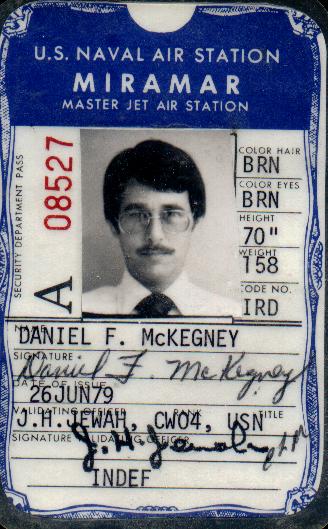
by Dan F. McKegney (Copyright 2001) Among my reasons for writing this story is for Kristin, Sarah, and Elicia, my lovely and "Good morning, Captain Cole." Just seconds after the last word left the tip of my tongue, I His name was Cole Black. Captain Black, if you please: an O-6 Naval officer, equivalent in Surely, I thought later, and for the good of humanity, I deserved to be issued my formal Idiot's License. I'd just passed the tepid requirements for such licensing. Despite my mistake, I recall that Captain Black had simply smiled, shook my hand, and acted as if nothing out of the ordinary had just happened. "Good morning, Dan" is how he replied, while obviously excusing my "civilian" gaff. Or at least I wanted desperately to believe that my first faux pas in protocol had been somehow overlooked. Less confident than ever before, I proceeded into the meeting room to take my seat towards the rear of a long, rectangular table for my first-ever Command level staff meeting at NAS Miramar. As the Executive Officer, XO, of NAS Miramar in 1979, Captain Black sat next to Miramar's Commanding Officer, CO, during those Monday morning staff meetings. Both the CO and XO sat at the head of that long table, around which was seated Miramar's Department Heads. I sat there too, as the Miramar civilian personnel Department Head. During those meetings Captain Black would interject his comments, opinions, and humorous remarks. Everyone would quietly listen as he spoke. There always seemed to be a kind of additional level of respect that would be accorded to Captain Black by that Monday morning assembly of Department Heads. One could just feel it. Additional respect was in the air. It was palpable. And, rightly so. ************ Naval Air Station Miramar was a special place in 1979. Captain Black, the XO there, was a special man. By the time he was re-assigned to another Navy duty station in 1981, I had by then worked for him for about two years. In 1979 NAS Miramar was also known as "Fightertown, U.S.A.", the home for training Navy and Marine Corps fighter pilots in the life and death aerial ballet of dogfighting in jet-powered machines far above the earth’s surface. "Fightertown U.S.A." entered into the popular consciousness by the 1986 release of the movie "Top Gun", starring Tom Cruise. Maverick, the young fighter pilot Cruise portrayed in the movie, was similar to the Captain Black I knew: both had a boundless energy, an enthusiasm for what they were doing, and a clarity of purpose. There the similarities ceased, however. In 1979 Captain Black was by then a desk-bound Navy fighter pilot, a Naval officer charged with administrative duties. Maverick was just a fictional character, a celluloid jet jockey. Captain Black had been the genuine article, the real deal, a bona fide sky warrior. He had possessed the "right stuff". He was also a man who'd spent nearly seven years as a prisoner of war, a POW, in North Vietnam. By 1979 I was a civilian in my early thirties working for the Navy. I was a "sandcrab" in charge of civilian personnel administration at Miramar, who was suddenly thrust into the company of Naval Air Station Department Heads. I had served a 4 year enlisted tour with the Air Force years before, getting out in 1971. I'd served my year in Vietnam, 1967 - 1968, at Tan Son Nhut Air Base(Saigon). But Captain Black was shot down in 1966 while flying his F8E Crusader over North Vietnam before I ever got to the South. He spent nearly seven years in North Vietnam as a POW. In 1973 he was released from the Hanoi Hilton during Operation Homecoming. Now in 1979, Captain Black was my immediate supervisor, my boss. I knew of his past, or at least that part of his that most closely paralleled that of mine. We never spoke about it. Captain Black, or "XO", as I soon learned to call him, was a little shorter than my nearly six feet. Yet, he was thickly and strongly built and had a brisk and hearty handshake. An energetic man, his dark eyes would fixate on anyone with whom he came in contact as he greeted people with a broad, friendly smile. Even though he was in his late forties in 1979, one could not help but notice his youthful appearance, an appearance which starkly contrasted with his nearly white hair. "Dan, XO here. Can you come down to my office as soon as possible? Yes sir, will be there shortly", I would reply as I started to hang up the phone and reach for my topcoat. I was always glad to get a phone call from the XO, even though I knew it meant that something was "up" in the civilian side of the house --- something that I’d probably not heard bout like a Congressional inquiry regarding one of our civilian employees or a letter from our civilian labor union that had been sent directly to the CO. I always expected the unexpected when asked by Captain Black to come to his office. Though assigned to desk duty, Captain Black was thoroughly a fighter pilot in the truest sense. On a small table across from his desk there stood a small, hand-held radio receiver. It was always on, monitoring the aircraft/tower transmissions at Miramar. His office seemed never to be without those crackling radio sounds between the Miramar tower and fighter aircraft. Whether taxiing on the runway, taking off, or in the process of landing, the tower/aircraft radio transmissions could clearly be heard in the background during our meetings in his office. Occasionally, his attention would be momentarily diverted if there were transmissions of particular import, as only he would know. On one occasion, and after hearing a particular radio exchange between aircraft and tower, he invited me outside the Miramar Headquarters building to view the runway action. There I proudly stood next to him, while my eyes followed the direction his arm showed as he pointed towards a fighter plane attempting a landing at Miramar. I listened to his description of the action, though without fully understanding. While his body was earthbound, Captain Black's spirit was surely with the pilot landing that plane. That plane touched down and stopped safely. October 1980. An open house and air show at NAS Miramar, San Diego and featuring the "Blue Angels". Though he was XO at Miramar at the time, Captain Black, thoroughly a fighter pilot, helped to honcho that show. E-2s, A-7s and 6s, F-4s, F-14s, F-5, F-8s and A-4s all took off at about 1230 hours. There was a flying formation as the national anthem was played. The U.S. Navy Parachute Team did a demonstration for the assembled audience, members of the public. There were many other demonstrations of flight operations. The finale involved an aerial demonstration by the "Blue Angels" ... Navy fighter jets swooping and swarming across and into the San Diego skies. And wowing the audience, to a person, all the while. I knew that Captain Black was pleased by the air show. Monday mornings at NAS Miramar. Those Command staff meetings began sharply at 0900. Now that I think back I'm certain that each of the attendees, and in his own way, must have listened to Captain Black with a certain sense of respect and envy. Yes, envy. Certainly not for the isolation, the torture and imprisonment that he had endured for so many years as a POW. Rather, it was an envy, a jealousy, regarding the depth of self-knowledge that he seemed to possess because of his POW experience. His was a kind of self knowledge that none of us sitting around that table had. For none of us, I believe, had been through a similar crucible of human experience. How would I, or any of us for that matter, have responded to the adversity that Captain Black had experienced? Would I have been as strong as he? Who would I have become? Would I have endured? What would I have become? Did I have the grit, theresolve, resilience to endure as had Captain Black? I didn't know then, nor do I now know the answers to any of those questions. What I do know is this ... if I could fit into my old Air Force uniform, Captain Black, I would salute you, sir. Was a pleasure working for you. There were never any noteworthy exchanges between Captain Black and I regarding Vietnam. That was something that was just not done then. That is how it should have been. But now is different and it is within today's times that I say to Captain Black: "Welcome Home Brother!  |
 "A Real Top Gun" - My Memory Of An Ex-POW
  |
||